Business & Industry
What event technology actually costs, and which decisions move the number
Four inputs drive most of an event technology budget. Three of them are yours to change, and one of them is time.
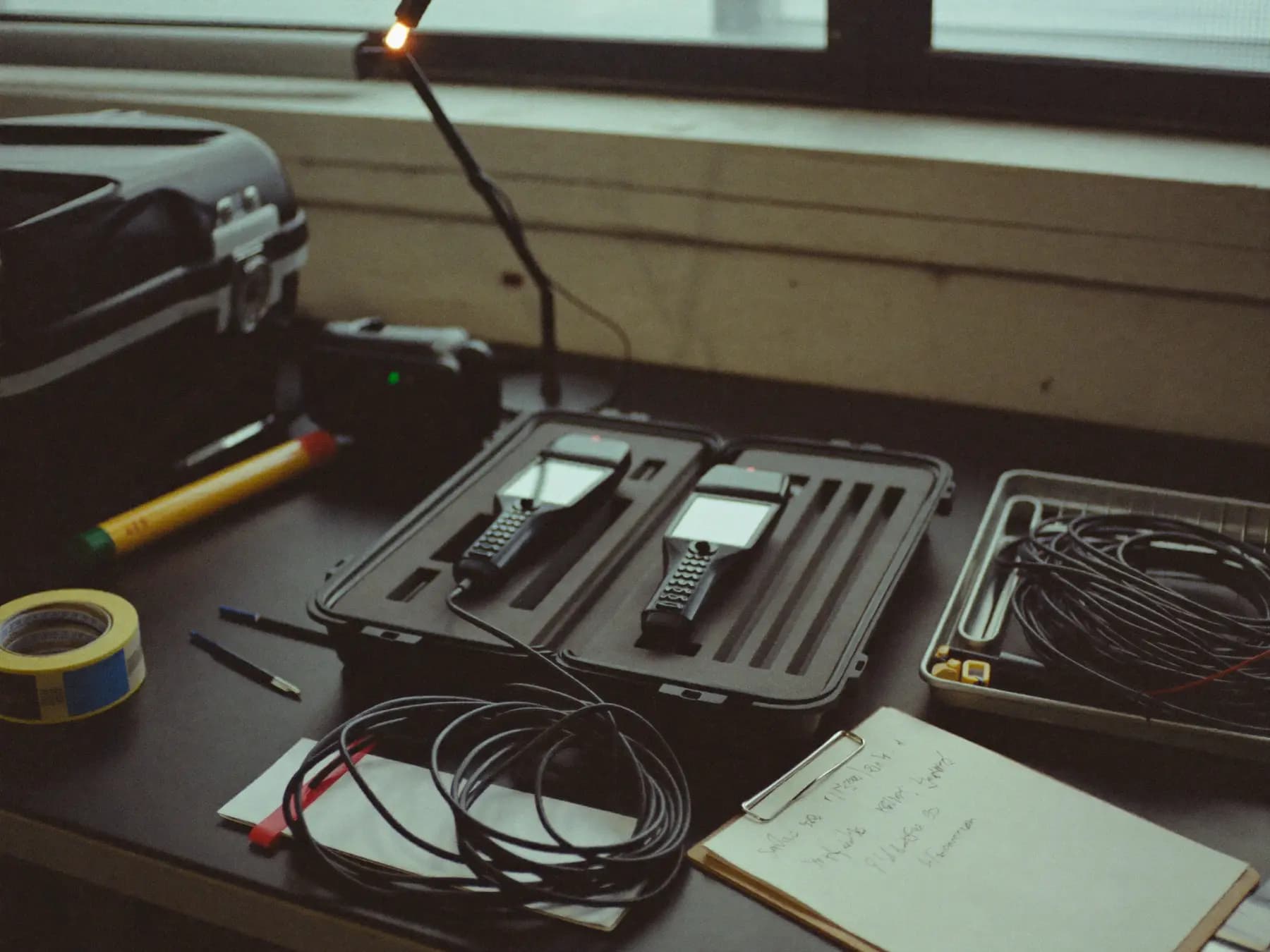
Hero art direction: Kit prep bench in a warehouse: open flight cases, scanners in a charging rack, coiled cables, packing list on a clipboard.
The four inputs
Almost every event technology quote is driven by:
- Delegate count — drives badge stock, counters, staff and licence tiers
- Show days — drives crew, kit rental and per-day rates
- Parallel halls — drives everything that has to exist in each room
- Lead time — drives whether the cheap options are still available
The first three are usually fixed by the event. The fourth is the one organisers control and consistently give away.
Lead time is a cost, not a preference
Under three weeks, several cheaper options simply stop existing:
- Pre-printed badge stock needs about ten working days. Without it you print on demand, which needs roughly three times the counters for the same throughput.
- Planned freight becomes expedited freight.
- Crew booking moves from scheduled to premium, because you are now competing for people already committed elsewhere.
The surcharge on a short lead time is not a penalty for urgency. It reflects the fact that the efficient version of the job is no longer available. We apply roughly 18% under three weeks and 6% under six, and the number is arithmetic rather than attitude.
Where the money actually goes
For a typical 2,000-delegate, two-day conference with registration, badging and streaming:
- Crew is usually the largest single line. Event technology is a labour business wearing a hardware costume.
- Kit rental — the second largest, and the one most sensitive to the parallel-hall count. Two halls needing streaming means two of everything.
- Consumables — badge stock, lanyards, printer media. Scales linearly with delegates and is easy to forecast.
- Software and licensing — usually the smallest line, and the one clients expect to dominate.
That last point surprises people. The registration platform is rarely the expensive part; the counters and the people staffing them are.
The decisions that move the number most
Reduce parallel halls needing full technical coverage. Two streamed halls instead of three is a large saving. Not every room needs a camera.
Move to pre-printed badges and accept a registration cut-off. Reduces counters, which reduces staff, which reduces floor space.
Decide honestly whether you need to stream. A well-produced recording published afterwards costs a fraction of live production and, for a lot of content, gets more total watch time.
Book earlier. Free, and the largest single lever available.
What not to cut
Spares. A printer failing at 08:20 with 900 people waiting is not a cost saving.
The dry run. The evening-before rehearsal against the real network is where problems are found while they are still cheap. Cutting it saves a few hours of crew time and moves the discovery to show morning.
The exception desk. Every event has delegates who are not on the list. Without somewhere to send them, they stay in the main queue and slow everyone behind them.
Getting to a real number
An indicative band is available in minutes from the four inputs above. A costed quotation needs the venue survey, the arrival data and the hall plan, because those change the counter count and the crew size, which is where the money is.
Be suspicious of a firm price offered before anyone has asked about your arrival curve.
Questions we get
Follow-ups
01Why is there a range rather than a price?
Because the inputs that decide the final figure — venue constraints, arrival curve, load-in window — are not known at enquiry stage. A single number quoted before those are known is either padded to cover the worst case or will move later. The band is the honest version.
02Is it cheaper to buy equipment than rent it?
Only above roughly eight to ten events a year with consistent requirements, and only if you also budget for storage, maintenance, calibration and the replacement cycle. For most organisers rental is cheaper and always current, and the kit is somebody else's problem between shows.
03How much should we hold as contingency?
Ten per cent of the technology budget covers the usual: additional counters on the day, an unplanned hall, extended hours. Events with a moving delegate count or an unconfirmed venue should hold more, because both of those change the sizing rather than just the volume.
Talk to the team that runs this on the floor
Send the date, the city and the headcount. We reply with numbers.
Further reading

Was this useful?