Event Operations
LED wall or projection: the four questions that decide it
Ambient light, viewing distance, ceiling height and load-in window. Answer those and the choice makes itself.
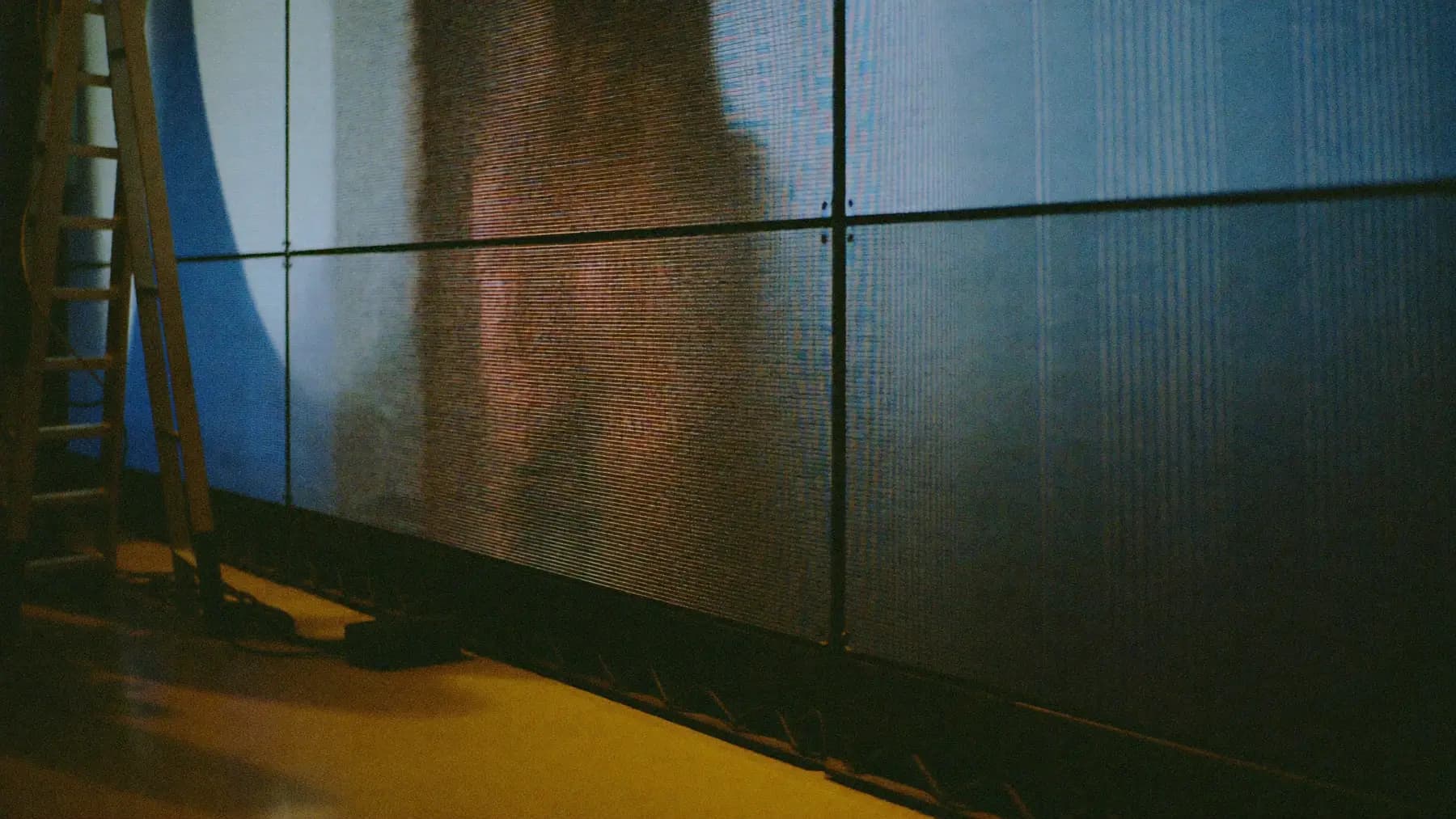
Hero art direction: Large LED wall photographed from a steep side angle so the panel seams and mounting frame read as texture, ladder at the base.
The decision is made by the room, not by preference
Both technologies work. Which one is right is determined almost entirely by four properties of the space, and arguing about image quality in the abstract wastes everyone's time.
1. How much ambient light is there?
Projection loses contrast as ambient light rises. In a hall with daylight, or one where the house lights must stay up for note-taking, a projected image looks washed out no matter what the lumen figure on the spec sheet says.
LED emits its own light and holds up in a bright room. If your hall has windows you cannot black out, the decision is largely made.
2. How close is the nearest seat?
LED has a pixel pitch — the distance between LEDs. The rule of thumb is that the minimum comfortable viewing distance in metres is roughly the pitch in millimetres. A 3.9 mm panel looks solid from about four metres and grainy from two.
Projection has no such constraint at the front, but it has a person-shaped one: anyone between the projector and the screen casts a shadow, unless you rear-project, which needs depth behind the screen that most halls do not have.
3. What is the ceiling height and rigging capacity?
LED panels are heavy. A large wall needs either a ground-support structure, which consumes floor depth, or rigging points rated for the load, which the venue has to actually have rather than theoretically have.
Projection needs throw distance and a mounting position, which is usually easier, and a screen that is far lighter.
4. How long is the load-in?
An LED wall is assembled panel by panel and takes crew and hours. A projection screen goes up quickly.
On a tight overnight load-in with a passenger lift as the only route, that difference can decide the whole design.
What it costs, roughly
LED is typically two to four times the rental cost of an equivalent projected image, before the structure and the extra crew. It also draws considerably more power, which loops back into your distribution plan.
That premium buys brightness, contrast and a surface that reads as part of the set rather than as a screen.
The honest recommendation
For a conference hall with controllable lighting, a stage set back from the audience and a normal load-in: projection, and spend the difference on content.
For a bright hall, an exhibition floor, a brand activation, or anywhere the screen is the set: LED.
The failure mode we see most is an LED wall specified for prestige in a room where a projector would have looked identical to every delegate, with the difference spent on panels instead of on the thing being shown.
Questions we get
Follow-ups
01What pixel pitch do we need?
For a stage backdrop viewed from six metres or more, 3.9 mm is comfortable and 2.6 mm is generous. For an exhibition stand where people stand a metre away, you need 1.5 mm or finer, and the cost rises steeply as pitch falls.
02Can we mix LED and projection in the same room?
Yes, and it is often the right answer — LED for the main stage where brightness matters, projection for side screens where it does not. Colour-match them at rehearsal, because an uncorrected LED wall next to a projected image will not agree on white.
03Does LED need different content preparation?
It needs content built to the wall's actual pixel dimensions, which are rarely a standard aspect ratio. Get the exact resolution from the supplier before the content is designed, because scaling a 1920-wide deck onto an irregular wall produces soft edges and unhappy designers.
Talk to the team that runs this on the floor
Send the date, the city and the headcount. We reply with numbers.
Further reading
Was this useful?