Event Operations
Badge printing is a heat problem before it is a software problem
Thermal printers slow down as they warm up. If you sized your desk on the first-hour rate, the second hour will surprise you.
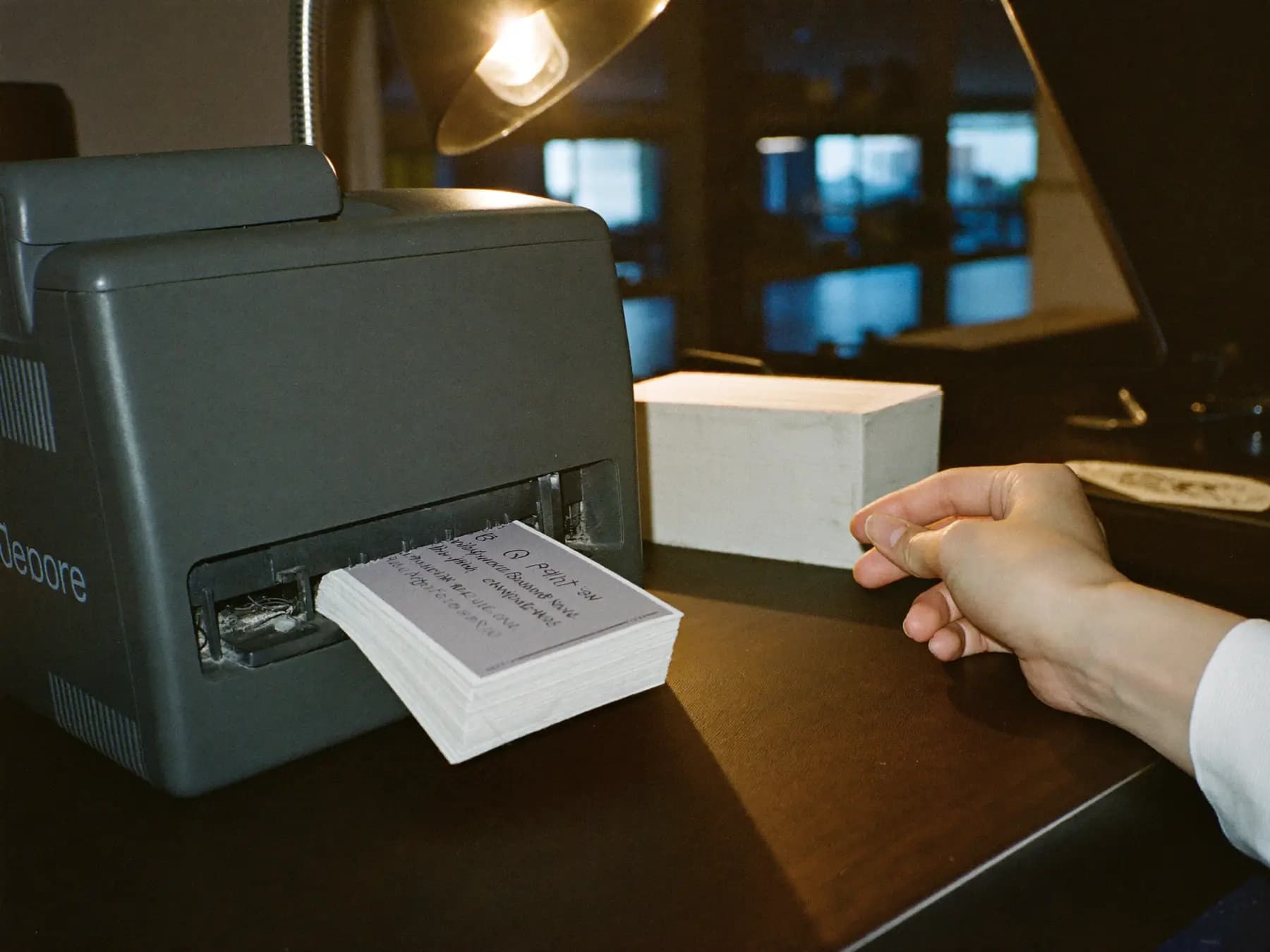
Hero art direction: Close crop of a thermal badge printer mid-cycle, badge half-ejected, operator's hand on the stack. Warm practical light, cool ambient behind.
The rate you tested is not the rate you get
Direct thermal and thermal-transfer printers both work by heating a print head against stock. The head has a duty cycle. Run it continuously and it heats past its target band, at which point the firmware slows the feed to protect the head.
This is not a fault. It is the printer doing what it was designed to do. But it means the throughput you measured in a ten-minute test on a cold printer is the best number that printer will ever produce, and your registration desk will not see it again after about twenty minutes of sustained work.
Plan against the sustained rate, not the burst rate.
What the numbers look like in practice
Across the desks we have instrumented, a mid-range thermal badge printer holds roughly:
- 1,100 to 1,300 badges an hour for the first fifteen minutes, cold
- 850 to 950 badges an hour sustained, once thermally settled
- 600 an hour and falling, if it is in direct sun or boxed into an unventilated counter
The gap between the first figure and the second is about 25%. On a 3,000-delegate morning that is the difference between clearing the hall and not.
The three things that actually move the number
Ventilation. A printer inside a closed counter recirculates its own heat. Cutting a vent in the back of the counter, or simply leaving the rear panel off, recovers most of the throttling loss. This is the cheapest fix on this list by a wide margin and it is routinely skipped because the counter looks tidier closed.
Stock quality. Cheap card stock has inconsistent thickness. The feed mechanism compensates, mis-feeds occur, and every mis-feed costs the operator twenty seconds of clearing plus a reprint. A jam rate of one in 300 sounds negligible until you multiply it across 3,000 badges and realise it is ten interruptions during your peak.
Duplicate printers per counter. Two printers on one counter, alternating, lets each cool between jobs. This is more effective than adding a whole extra counter and it does not need extra floor space or extra staff.
Pre-printing changes the question entirely
If badges are pre-printed and sorted into surname blocks, the printer is out of the critical path. The counter becomes a lookup-and-hand-over operation at around nine seconds a delegate, and printers only run for the walk-ups.
The cost is lead time. Badge stock and print runs need roughly ten working days, which means a cut-off date for registrations, which means somebody has to own the decision that late registrants are onsite registrants. That is an organisational commitment more than a technical one, and it is usually the real blocker.
What to check before show day
Run a sustained test, not a burst test. Print 400 badges continuously and record the time for the first hundred and the time for the last hundred. If the last hundred is more than 20% slower, you have a ventilation or placement problem you can still fix.
Check the print head temperature warning in the printer's own diagnostics. Most units expose it and almost nobody looks.
Finally, count your spares. A printer that fails at 08:20 with 900 people still to check in is not a maintenance issue, it is an incident. One spare per four working units is the ratio we deploy.
Questions we get
Follow-ups
01Is thermal-transfer better than direct thermal for event badges?
For same-day events, direct thermal is fine and cheaper — the badge does not need to survive beyond the show. For multi-day events, or anywhere badges get handled in heat, thermal transfer holds up better because the image is a resin layer rather than a heat-reactive coating. Direct thermal badges left in a car window will darken.
02How many printers do we need for 2,000 delegates?
It depends on the arrival curve, not the headcount. If 60% arrive in a 90-minute window, that is 1,200 badges in 90 minutes, or 800 an hour. At a sustained 900 an hour per printer you need two working units plus a spare — but if the same 2,000 arrive over four hours, one plus a spare is enough.
03Can we print badges on demand from a QR scan instead?
You can, and it removes the pre-print lead time. It costs you 20 to 30 seconds per delegate at the counter against nine for pre-printed collection, so you need roughly three times the counters for the same throughput. On a large event that trade is usually worse than accepting a registration cut-off.
Talk to the team that runs this on the floor
Send the date, the city and the headcount. We reply with numbers.
Further reading



Was this useful?